domingo, 27 de enero de 2013

MUMMY

MUMMY. The origin of mummification in Egypt has given rise to much learned conjecture , now, however, superseded by positive knowledge, -- comparative study of sepulchral texts having furnished Egyptologists with convincing proof that the inviolate preservation of the body was deemed essential to the corporeal resurrection of the "justified" dead. The living man consisted of a body, a soul, an intelligence, and an appearance or eidolon, - in Egyptian, a ka. Death dissociated these four parts, which must ultimately be reunited for all eternity. Between death on earth and life everlasting there intervened, however, a period varying from 3000 to 10,000 years, during which the intelligence wandered, luminous, through space, while the soul performed a painful probationary pilgrimage through the mysterious under-world. The body, in order that it should await, intact, the return of the soul whose habitation, it was, must meanwhile be guarded from corruption and every danger. Hence, and hence only, the extraordinary measures taken to ensure the preservation of the corpse and the inviolability of the sepulcher; hence the huge pyramid, the secret pit, and the subterraneous labyrinth. The shadowy and impalpable ka – the mere aspect, be it remembered, of the man – was supposed to dwell in the tomb with the mummied body. This fragile conception was not, however, indestructible, like the soul and the intelligence. Being an aspect, it must perforce be the aspect of something material; and, if the body which it represented were destroyed or damaged, the ka was liable to the like mischance. In view of this danger, the Egyptian, by stocking his sepulcher with portrait statues, sought to provide the ka with other chances of continuance, these statues being designed, in a strictly literal sense, to serve as supports or dummies for the ka. The funereal portrait statues of the ancient empire (Dynasties I. to VI.) are marvels or realistic art in basalt, diorite, limestone, and wood. As many as twenty duplicates have been found in a single tomb, and always secreted in hidden chambers constructed in the thickness of the walls of the sepulcher. The Bulak Museum is very rich in ka statues of the ancient empire; and the British Museum contains two in wood from the tomb of Seti I., of the period of Dynasty XIX.
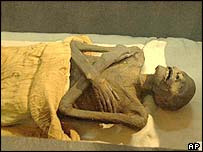
Mummies image

Mummies

For the processes of mummification, as narrated by Greek and Latin authors, see EMBALMING. The details which follow are taken from original Egyptian sources.

The embalmment of a man of wealth, done in the costliest manner, consisted of – (1) the "going into the good abode," (2) the Teb, (3) the Kesau. The first of these was the process of evisceration, cleaning, &c., which occupied 15 or 16 days; the second was the salting or bituminizing, and took 19 or 20 days; the third wad the spicing and bandaging, and took 34 or 35 days, - making 70 or 72 days in all. there were four special "rituals" for the guidance of the priestly operators and assistants – (1) that of "going into the good abode," which was a kind of surgical manual for the use of the paraschists, enumerating the incisions to be made in the body; (2) that of "the Kesau," a corresponding manual for the use of the tarischeutes, containing lists of the necessary gums, resins, spices, &c., directions as to number and nature of the bandages, and prayers to be repeated while adjusting them; (3) the "water ritual" or service-book of litanies, to be recited during the transport of the mummy to the cemetery, which was almost always done by boat; (4) the funereal ritual, performed on consigning the mummy to the tomb. No copy of the first of these documents is known, but its substance is summarized in the Rhind papyrus. Of the other three, contemporary copies written on papyrus exist in various museums. Establishments for the reception and mummification of the dead were attached to all the great cemeteries. These mortuary suburbs, by the Greeks called "memnonia" were inhabited by a large population of embalmers, mummy-case makers, gilders, painters, scribes, priests, and the like; and its has been calculated that from 500 to 800 corpses must always have been on hand in the workshops attached to the necropolis of Memphis. To prevent mistakes in delivering the mummies to their families, the bandagers were in the habit of marking the wrappings with the name and age of the deceased, sometimes adding the name and regnal year of the king in whose time he died. The ink in which these entries were written was made from nitrate of silver, like the marking-ink of he present day. The bandages were of linen only. The texture varied with he rank of the mummy, some being as fine as the finest India muslim, and some extremely coarse. The quantity used was enormous, and persons used to save their old linen for this purpose all their lives long. Each limb, finger, and toe was first separately swathed; and finally the whole body was enveloped in numberless convolutions, the contours of the shrunken form being skillfully restored by means of padding. From 700 to 1250 yards of bandages, in strips of 3 to 4 inches wide, have been found on mummies.

The processes of mummification varied in different parts of Egypt and at different periods. The mummies made at Memphis are black, dry, and brittle, whereas those of the best Theban epoch are yellowish, flexible, and so clastic that the flesh yields to the touch of the finger and the limbs may be bent without breaking. Champollion-Figaec attributes this exquisite softness and elasticity to the injection of costly chemical liquids into the veins, whereby the substance of the flesh was preserved. The matron process, on the contrary, on the contrary, destroyed the flesh, leaving only the skin and the bones. By some schools of embalmers the cavity of the skull, after the withdrawal of the brain, was washed out by an injection of refined bitumen, the effect of which was to preserve the membranous covering which has frequently been found inside the brain-pan, dried and unimpaired. Hair is constantly found on the heads of mummies, sometimes plaited, sometimes frizzled, - thus showing that the fashion of wearing wigs was by no means universal. The under bandages of mummies were laid on wet, having probably been dipped in spirits. They sometimes come off with the solidity of a pasteboard mask; and life-like portraits of the dead have been reproduced by simply casting plaster into these masks as into a mould. When Syrian turpentine came into use the Theban mummies ceased to maintain their supremacy, and became even blacker than those of Memphis, the corpse and its bandages forming one solid mass almost as hard as stone. In Memphite mummies, especially of the Ramesside and Saitic periods, the cavity of the chest is found filled with scarabaei and amulets in pietra dura. The Theban mummies, on the other hand, from Dynasty XI. to Dynasty XXIII., were adorned with rings, pectoral ornaments, collars, bracelets, &c., in exquisitely-wrought gold inlaid with lapis-lazuili, carnelian, green felspar, and other precious stones. Under the Greeks and Romans the art of mummification declined. Rudely-painted wooden coffins were substituted for the granite sarcophagi and richly-decorated mummy-cases of former times. The mummies became ashen-grey, or, being boiled in bitumen, were black, heavy, and shapeless. Those of Graeco-Roman times are frequently found wrapped in painted shrouds, and sometimes with coarsely-daubed encaustic portraits on panel laid above the faces. Dr Birch gives 700 A.D. as the date at which mummification practically ceased. It was formerly supposed that the bodies of the dead were merely desiccated under the ancient empire, and that actual embalming was not practiced before 2000 B.C. Recent explorations among the ruined pyramids of Sakkarah have, however, brought to light the mummied corpse of King Merenra, and part of the mummy of King Pepi, his father, both of Dynasty VI. Though denuded of its wrappings by ancient tomb-breakers, the mummy of Merenra is distinctly impressed in the usual manner with marks of its former bandages; and portions of the bandages and a "well-embalmed" hand were recovered from the debris of that of King Pepi. It is thus shown that mummification was an established rite towards the close of the ancient empire, and that the processes then in use were identical with those of later times, which compels us to ascribe a very early date (possibly 3800 or 4000 B.C.) to the beginnings of the art.


The styles of sarcophagi and mummy-cases vary according to periods and places as much as do the styles of muumification. At Gizeh, Sakkarah, and Meydum, in tombs of the ancient empire (Dynasties I. to VI.), the dead are found in unpainted wooden coffins with carved human faces, these coffins being enclosed in massive rectangular sarcophagi of black basalt, red granite, and limestone. Interments of the earliest Theban period (Dynasty XI.) yield cases shaped like the mummy within, and carved out of solid tree-trunks. The masks are painted yellow, white, or black, and on the breast Isis and Nephthys are depicted as if overshadowing the mummy-case with their wings. These cases are sometimes found enclosed in large rectangular wooden coffers with flat lids. With Dynasty XVII. (Theban) there appears the mummy-case with hands carved in relief and crossed upon the breast. The ground-color of these cases is generally white or black, painted with transverse bands of hieroglyphed inscriptions, the mask is red or gilded, and a vulture with extended wings is depicted on the breast. From Dynasty XIX. To Dynasty XXI. The coffins are highly ornamented in gay colors, figures being more abundant than inscriptions, and yellow varnishes much in favor. The mummy is frequently found enclosed in two, three, and even four such cases, each a size larger than the last. Cases with black grounds are succeeded by cases with brown grounds, and these again by white, resembling those of Dynasties XVII. And XVIII. The masks are now painted red, with richly-decorated head-dresses imitating wigs. Under the priest-king or Amenide domination these triple and quadruple "nests" of mummy-cases are found enclosed in gigantic rectangular outer sarcophagi of wood, highly painted and varnished. From Dynasty XXII. to Dynasty XXVI. the inscriptions are mostly painted in green on a while ground. At Memphis, meanwhile, the granite basalt, or limestone sarcophagus – sometimes rectangular with rounded corners, sometimes mummy-shaped with sculptured hands and feet, sometimes resembling a long bath – continued to hold its ground. The Saitic period (Dynasties XXVI. to XXX.) is distinguished by the minute finish and artistic beauty of its sculptured sarcophagi in basalt and granite. Last of all, in the extreme decadence of the art, come squared wooden coffins, unpainted, unvarnished, and rudely scrawled in ink with hieroglyphed legends so corrupt as to be almost illegible. According to the religious law of ancient Egypt, the rites of mummification were universal and compulsory, being performed, not only for every native in a style consistent with his rank in life, but also for all strangers and foreigners who died in the land, for all slaves and captives, and even for outcasts, criminals, and lepers.

The most ancient mummified – or, at all events, desiccated – human remains, not being pre-historic, which are known to science are the fragments of the body of Menkara (Gr., Mycerinus), third king of Dynasty IV., and builder of the smallest of the three great pyramids of Gizeh. These fragments were found by Colonel Howard Vyse strewn on the floor of the upper chamber of that pyramid, together with the woolen wrappings and empty cedar-wood coffin of this pharaoh. All these are now in he British Museum. The fragments consist of the ribs and vertebrae and the bones of the legs and feet, the dried flesh upon the thighs being perfectly preserved. The date of these remains may be approximately assigned to 4000 B.C. Next in antiquity comes the mummy of King Merenra of Dynasty VI., now in the Bulak Museum, the date of which is about 3600 B.C. Most famous and most interesting of all, however, are the royal mummies of Dynasties XVII., XVIII, XIX., and XXI., found at Dair al-Bahari, near the great temple of Queen Hatshepsu, on the left bank of the Nile opposite karnak, in July 1881. The circumstances of this, the most extraordinary archaeological discovery of any age, are too remarkable to be passed over in silence.

The so-called "Theban Arabs" are the busiest treasure-seekers and antiquity-vendors in Egypt. But not often, apparently, have they lighted upon a royal internment. The royal sepulchers in the Valley of the Tombs of the Kings and the neighborhood have tempted the cupidity of all ages; and we have the direct evidence of two legal documents of the time of Rameses IX., 7th pharaoh of Dynasty XX., to show that bands of organized tomb-breakers infested the cemeteries of Thebes at that comparatively early period.


It is now about twelve years since certain objects of great rarity and antiquity, mostly belonging to the period of the Amenide Dynasty (XXI)., began to find their way to Europe from Upper Egypt. Foremost in importance among the said relics were four funereal papyri (consisting of extracts from the Ritual or Book of the Dead written for royal personages of the Amenide family. Concurrent testimony pointed to a family of Arab brothers named Abd er Rasoul as the original holders of these papyri; it was therefore concluded that the tombs of Pinotem I. and of the Queens Notem-Maut and Hathor Hont-taui (for whom the papyri were written) had by them been discovered and pillaged. The eldest brother was ultimately induced to reveal the secret, and pointed out a lonely spot at the foot of the cliffs not far from the ruins of the great temple of Hatshepsu, on the western bank of the Nile, where the bottom of a hidden shaft opened into a short corridor leading to a gallery 74 meters in length, at the end of which was a sepulchral vault measuring 7 meters by 4. the whole of this gallery and vault were crowded with mummies and mortuary furniture, as sacred vessels, funereal statuettes, canopic and libation vases, and precious objects in alabaster, bronze, glass, acacia wood, and the like. The mummies were thirty-six in number, including upwards of twenty kings and queens from Dynasty XVIII. to Dynasty XXI., besides princes, princesses, and high priests, all of which, together with four royal papyri and a miscellaneous treasure consisting of upwards of 6000 objects, are now in the Bulak Museum.

The door-jambs of the mortuary chamber at the end of this long gallery are inscribed with various attestations of burial. These entries refer to interments of members of the Amenide line only. It is also to be observed that only members of that line were found inside the chamber, so proving that the sepulchure was the family vault of the descendants of the first priest-king. All the other royal mummies, and all the objects appertaining to those mummies (that is to say, to the representatives of dynasties XVII, XVIII., and XIX.) were found in the long gallery outside. When these earlier kings, queens, and princesses were brought out into the light of day, and conveyed to the museum of Bulak, it was discovered that the coffins of some, and the wrappings of others, were inscribed with short official entries written thereon at different times and in different places by successive inspectors of tombs. The dates of these visits of inspection are restricted to the period of Dynasty XXI., whence it is evident that the necessity for protecting the last homes of the illustrious dead was as urgent then as the "Amherst" and "Abbott" papyri prove it to have been in the reign of Rameses IX. The terms of these entries show that it was the duty of the said inspectors to enter the sepulchers of the "royal ancestors," to report upon the condition of the mummies, to repair their wrappings and mummy-cases when requisite, and, if expedient, to remove them from their own tombs into any others which might be regarded as more secure. The mummies and mummy-cases thus inscribed are five in number – namely, those of Amenhotep I., Thothmes II., Rameses I., Seti I., and Rameses II. Two entries on the coffin-lid of Amenhotep I. show his tomb to have been inspected and his wrappings, renewed in the 6th year of Pinotem II., fourth of the priest-king line, and again in the 16th year of the pntificate of Masahirtim, his son and successor. In the 6th year of Pinotem I. the same was done fo rthe mummy of Thothmes II. The three pharaohs of Dynasty XIX. – Rameses I., Seti I., and Rameses II. – seem, however, to have been still more anxiously looked after. Either because their mummies were specially revered, or because their sepulchers had already been attacked by the tomb-breaking gangs of that period, we find them continually being removed from one tomb to another. In the 6th year of Her-Hor, the founder of the Amenide line, while they yet occupied their own splendid sepulchers in the Valley of the Tombs of the Kings, they were there examined by a Government inspector, who "renewed their funerary equipments" and made an entry of his visit on the coffins of Seti I. and Rameses II. After this Ramese I. and Rameses II. were removed to the tomb of Seti I. (the tomb known as Bezoni’s), whence, in the 16th year of Her-Hor, all three mummies, father, son, and grandson, were transferred to the tomb of Queen Ansera. This act of transfer is written, dated, signed, and witnessed on all three coffins. Again, in the 10th year of Pinotem I., grandson of Her-Hor, occur more intries showing them tohave been conveyed from the tomb of Queen Ansera to the tomb of one of the Amenhoteps. Finally, in bold hieratic characters, written with marking-ink upon the breast-bandages of Rameses II., we find the following memorandum recording how, ten years later still, the mummy of this illustrious pharaoh was again taken back to the tomb of his father Seti I.:-

"The year 16, the third month of Pert (i.e., seed-time), the sixth day, being the day of carrying the defunct King Ra-user-Ma Sotep-en-Ra, for the renewal of his funerary appointments, into the tomb of the defunct King Ra-men-Ma Seti, by the first prophet of Amen, Pinotem."

At what precise date these and the earlier royal mummies were brought into the Dair al-Bahari vault does not appear; but, as that vault was finally closed on the burial of Queen Isi-em-Kheb, we may conclude that, as a last resource against possible depredation, the "royal ancestors" were deposited therein at or about that time. this would be in the reign of King Menkjeperra (brother and successor of Masahirti, and husband of Isi-em Kheb), whose seal, impressed on clay, was found upon the shattered door of the mortuary chamber. The condition of the various mummies and mummy-cases thus hospitably sheltered gives every indication that their original sepulchers had been previously violated. The coffins of Thothmes III. and Rameses I, are much damaged. That of Rameses II. was probably destroyed, since the one in which his mummy now reposes is of Dynasty XXI. Workmanship. The mummy of Rameses I. is doubtful, that of Thothmes I. is missing, as are also the coffins of Queen Ansera, Queen Merit-Amen, and Queen Sitka. The mummy of Thothmes III. – greatest of all Egyptian pharohs -- greater than even Seti I. or Rameses II. – is broken in three pieces. All this is apparently the work of ancient marauders.

For these identifications, see especially two articles on Dynasty XXI. (Manethonian ) in the Zeit. f. Aegyp. Sp., 1882, by Dr R. Lepsius and Dr A. Wiedemann; also in Recueil des Travaux, vol. iii., 1883, main article on "Relics from the Tomb of the Priest-Kings at Dayr el-Baharee," by Amelia B. Edwards.
GENERAL BIBLIOGRAPHY. – G Maspero, Sur la Cachette découverte à Der el-Bahari; Verhandlungen des Fünften Orientalisten-Congresses, Berlin, 1881; G. Maspero, La Trouvaille de Deir el-Bahari, Cairo 1881; A. Rhone, "Découverte des Momies Royales de Thebes," in Gazette des Beaux Arts, 1883; A. B. Edwards, "Lying in State in Cairo,"in Harper’s Monthly Magazine, July 1882; H. Villiers Stuart, The Funeral Tent of an Egyptian Queen, London, 1882; Colonel Howard Vyse, Operations carried on at the Pyramids of Gheezeh, &c., 1840-2; Sir J. G. Wilkinson, Manners and Customs of the Ancient Egyptians, new ed., London, 1878; Records of the Past, edited by Birch; E. Ledrain, Les Momies Gréco-Egyptiennes, Paris, 1877; T.J. Pettigrew, History of Egyptian Mummies, London, 1840; A.H. Rhind, Thebes, its Tombs and their Tenants, London, 1862. ( A. B. E.)


The article above was written by Miss Amelia Blandford Edwards, Egyptologist and novelist; founded a chair of Egyptology at Oxford; author of Debenham's Vow; A Thousand Miles up the Nile, and Pharoahs, Fellahs, and Explorers.

miércoles, 12 de diciembre de 2012

3D imaging helps understand the role of birds in ancient Egypt

Entering the exhibition “Between Heaven & Earth: Birds In Ancient Egypt” at the Oriental Institute Museum, University of Chicago, you will immediately feel transported into the ancient Nile delta marshlands with its lush green flora.
The combination of colours, video footage, bird song and ancient artefacts gives the impression of travel through time and space. At the start of the exhibition, you will find one of their most impressive artefacts, an empty shell of an ostrich egg from 3100 BC. Ostrich eggs have not only been used in ancient Egypt as containers for liquids and raw material for bead carving, but also symbolize the deep integration of avian life into ancient Egypt’s spirituality. All life is at times described as entering and leaving the world through the egg as a vessel, and that birds are messengers that can travel between the realms of men and their gods. Many of the Egyptian gods are portrayed as birds, and even their people have been symbolized by different bird species.

X-ray CT imaging

The information for the exhibition has been extracted from many sources such as ancient texts and drawings, exploration of burial sites, and with the help of X-ray CT imaging from mummified bird specimens. As shown impressively by Rozenn Bailleul-LeSuer, the reconstructed 3D X-ray images can be examined with Amira® 3D analysis software to extract the desired information and sometimes even discover surprises. Rozenn and her team of imaging scientists worked on several specimens.

Small falcon mummy

The most impressive imaging results were obtained from a small falcon (see above, not on display at the exhibit due to space limitations). The falcon’s size and its missing wrappings allowed this specimen to be imaged in a micro-CT system at a resolution of approximately 180μm; more than 40 times higher than the clinical imaging system used for larger specimens. Using Amira’s advanced segmentation functionality and volume rendering, which allows masking of segmented regions in the visualization, the exact species of the falcon could be determined. Furthermore, it was shown that its neck had been severed, but that internal organs were still intact. The intestines had been pushed to the posterior of the bird to make room for a filled gizzard. The images also revealed the contents of the gizzard, which was identified as the remains of a small rodent from a piece of intact jaw bone.

Juvenile Eurasian sparrow-hawk

CT images from another mummy revealed a small juvenile Eurasian sparrow-hawk. In this mummy, the wrappings were larger than required for a bird of this size. Missing bone calcification was evidence for the immaturity of the bird, and a posterior air pocket indicated penetration of insects that fed on the bird’s carcass. With this specimen, careful segmentation in Amira was the essential key for visualization of the mummy’s interior and identification of the bird. Here, the low calcification proved challenging during the segmentation process. Once the segmentation was completed, Amira’s crisp surface rendering allowed further analysis and identification.
A mummified juvenile sparrowhawk in its too large wrapping. The size of the mummy required image acquisition in a clinical CT, resulting in visualization of only coarse details. In addition the low bone calcification further reduces bone contrast. Image: Anna R. Ressman © Oriental Institute at the University of Chicago
“Between Heaven & Earth: Birds in Ancient Egypt” is an exciting exhibition combining traditional archaeological and anthropological methods with modern imaging techniques to inform the interested visitor about the role of birds in routine daily life as well as spirituality of ancient Egypt.
Source: Visualization Sciences Group/authors: Rozenn Bailleul-LeSuer & Christian Wietholt

More Information

The Oriental Institute is open to the public without an admission fee. The exhibition is open until 28 July 2013.
Additional information about this exhibit can be found at: http://oi.uchicago.edu/museum/special/birds


lunes, 10 de diciembre de 2012

THE ORIGIN OF EMBALMING

I have already explained 2 how the increased importance that came to be attached to the corpse as the means of securing a continuance of existence led to the aggrandizement of the tomb. Special care was taken to protect the dead and this led to the invention of coffins, and to the making of a definite tomb, the size of which rapidly increased as more and more ample supplies of food and other offerings were made. But the very measures thus taken the more efficiently to protect and tend the dead defeated the primary object of all this care. For, when buried in such an elaborate tomb, the body no longer became desiccated and preserved by the forces of nature, as so often happened when it was placed in a simple grave directly in the hot dry sand.
It is of fundamental importance in the argument set forth here to remember that these factors came into operation before the time of the First Dynasty. They were responsible for impelling the Proto-Egyptians not only to invent the wooden coffin, the stone sarcophagus, the rock-cut tomb, and to begin building in stone, but also to devise measures for the artificial preservation of the body.
But in addition to stimulating the development of the first real architecture and the art of mummification other equally far-reaching results in the region of ideas and beliefs grew out of these practices.
From the outset the Egyptian embalmer was clearly inspired by two ideals: (a) to preserve the actual tissues of the body with a minimum disturbance of its superficial appearance; and (b) to preserve a likeness of the deceased as he was in life. At first it
p. 16
was naturally attempted to make this simulacrum of the body itself if it were possible, or alternatively, when this ideal was found to be unattainable, from its wrappings or by means of a portrait statue. It was soon recognized that it was beyond the powers of the early embalmer to succeed in mummifying the body itself so as to retain a recognizable likeness to the man when alive: although from time to time such attempts were repeatedly made, 1 until the period of the XXI Dynasty, when the operator clearly was convinced that he had at last achieved what his predecessors, for perhaps twenty-five centuries, had been trying in vain to do.

Footnotes

15:2 Op. cit. supra.
16:1 See my volume on "The Royal Mummies," General Catalogue of the Cairo Museum.


 Evolution of the Dragon, by G. Elliot Smith, [1919], at sacred-texts.com

EARLY MUMMIES

In the earliest known (Second Dynasty) examples of Egyptian attempts at mummification 2 the corpse was swathed in a large series of bandages, which were moulded into shape to represent the form of the body. In a later (probably Fifth Dynasty) mummy, found in 1892 by Professor Flinders Petrie at Medlin, the superficial bandages had been impregnated with a resinous paste, which while still plastic was moulded into the form of the body, special care being bestowed upon the modelling of the face 3 and the organs of reproduction, so as to leave no room for doubt as to the identity and the sex. Professor Junker has described 4 an interesting series of variations of these practices. In two graves the bodies were covered with a layer of stucco plaster. First the corpse was covered with a fine linen cloth: then the plaster was put on, and modelled into the form of the body (p. 252). But in two other cases it was not the whole body that was covered with this layer of stucco, but only the head.
Professor Junker claims that this was done "apparently because the head was regarded as the most important part, as the organs of taste, sight, smell, and hearing were contained in it". But surely there was the additional and more obtrusive reason that the face affords the means of identifying the individual! For this modelling of the features was intended primarily as a restoration of the form of the body which had been altered, if not actually destroyed. In other cases, where no attempt was made to restore the features in such durable materials as resin or stucco, the linen-enveloped head was modelled, and a representation of the eyes painted upon it so as to enhance the life-like appearance of the face.
These facts prove quite conclusively that the earliest attempts to reproduce the features of the deceased and so preserve his likeness, were made upon the wrapped mummy itself. Thus the mummy was intended to be the portrait as well as the actual bodily remains of the dead. In view of certain differences of opinion as to the original significance of the funerary ritual, which I shall have occasion to discuss later on (see p. 20), it is important to keep these facts clearly in mind.
A discovery made by Mr. J. E. Quibell in the course of his excavations at Sakkara 1 suggests that, as an outcome of these practices a new procedure may have been devised in the Pyramid Age—the making of a death-mask. For he discovered what may be the mask taken directly from the face of the Pharaoh Teta (Fig. 3).
About this time also the practice originated of making a life-size portrait statue of the dead man's head and placing it along with the actual body in the burial chamber. These "reserve heads," as they have been called, were usually made of fine limestone, but Junker found one made of Nile mud. 2
Junker believes that there was an intimate relationship between the plaster-covered heads and the reserve-heads. They were both expressions of the same idea, to preserve a simulacrum of the deceased when his actual body had lost all recognizable likeness to him as he
was when alive. The one method aimed at combining in the same object the actual body and the likeness; the other at making a more life-like portrait apart from the corpse, which could take the place of the latter when it decayed.
Junker states further that "it is no chance that the substitute-heads … entirely, or at any rate chiefly, are found in the tombs that have no statue-chamber and probably possessed no statues. The statues [of the whole body] certainly were made, at any rate partly, with the intention that they should take the place of the decaying body, although later the idea was modified. The placing of the substitute-head in [the burial chamber of] the mastaba therefore became unnecessary at the moment when the complete figure of the dead [placed in a special hidden chamber, now commonly called the serdab] was introduced." The ancient Egyptians themselves called the serdab the pr-twt or "statue-house," and the group of chambers, forming the tomb-chapel in the mastaba, was known to them as the "ka-house". 1
It is important to remember that, even when the custom of making a statue of the deceased became fully established, the original idea of restoring the form of the mummy itself or its wrappings was never abandoned. The attempts made in the XVIII, and XXI and XXII Dynasties to pack the body of the mummy itself and by artificial means give it a life-like appearance afford evidence of this. In the New Empire and in Roman times the wrapped mummy was sometimes modelled into the form of a statue. But throughout Egyptian history it was a not uncommon practice to provide a painted mask for the wrapped mummy, or in early Christian times simply a portrait of the deceased.
With this custom there also persisted a remembrance of its original significance. Professor Garstang records the fact that in the XII Dynasty, 2 when a painted mask was placed upon the wrapped mummy, no statue or statuette was found in the tomb. The undertakers

apparently realized that the mummy 1 which was provided with the life-like mask was therefore fulfilling the purposes for which statues
were devised. So also in the New Empire the packing and modelling of the actual mummy so as to restore its life-like appearance were regarded as obviating the need for a statue.
I must now return to the further consideration of the Old Kingdom statues. All these varied experiments were inspired by the same desire, to preserve the likeness of the deceased. But when the sculptors attained their object, and created those marvellous life-like portraits, which must ever remain marvels of technical skill and artistic feeling (Fig. 4), the old ideas that surged through the minds of the Pre-dynastic Egyptians, as they contemplated the desiccated remains of the dead, were strongly reinforced. The earlier people's thoughts were turned more specifically than heretofore to the contemplation of the nature of life and death by seeing the bodies of their dead preserved whole and incorruptible; and, if their actions can be regarded as an expression of their ideas, they began to wonder what was lacking in these physically complete bodies to prevent them from feeling and acting like living beings. Such must have been the results of their puzzled contemplation of the great problems of life and death. Otherwise the impulse to make more certain the preservation of the body by the invention of mummification and to retain a life-like representation of the deceased by means of a sculptured statue remains inexplicable. But when the corpse had been rendered incorruptible and the deceased's portrait had been fashioned with realistic perfection the old ideas would recur with renewed strength. The belief then took more definite shape that if the missing elements of vitality could be restored to the statue, it might become animated and the dead man would live again in his vitalized statue. This prompted a more intense and searching investigation of the problems concerning the nature of the elements of vitality of which the corpse was deprived at the time of death. Out of these inquiries in course of time a highly complex system of philosophy developed. 2
But in the earlier times with which I am now concerned it found practical expression in certain ritual procedures, invented to convey to the statue the breath of life, the vitalising fluids, and the odour and sweat of the living body. The seat of knowledge and of feeling was believed to be retained in the body when the heart was left in situ: so that the only thing needed to awaken consciousness, and make it possible for the dead man to take heed of his friends and to act voluntarily, was to present offerings of blood to stimulate the physiological functions of the heart. But the element of vitality which left the body at death had to be restored to the statue, which represented the deceased in the ka-house. 1
In my earlier attempts 2 to interpret these problems, I adopted the view that the making of portrait statues was the direct outcome of the practice of mummification. But Dr. Alan Gardiner, whose intimate knowledge of the early literature enables him to look at such problems from the Egyptian's own point of view, has suggested a modification of this interpretation. Instead of regarding the custom of making statues as an outcome of the practice of mummification, he thinks that the two customs developed simultaneously, in response to the twofold desire to preserve both the actual body and a representation of the features of the dead. But I think this suggestion does not give adequate recognition to the fact that the earliest attempts at funerary portraiture were made upon the wrappings of the actual mummies. 3 This fact and the evidence which I have already
quoted from Junker make it quite clear that from the beginning the embalmer's aim was to preserve the body and to convert the mummy itself into a simulacrum of the deceased. When he realized that his technical skill was not adequate to enable him to accomplish this double aim, he fell back upon the device of making a more perfect and realistic portrait statue apart from the mummy. But, as I have already pointed out, he never completely renounced his ambition of transforming the mummy itself; and in the time of the New Empire he actually attained the result which he had kept in view for nearly twenty centuries.
In these remarks I have been referring only to funerary portrait statues. Centuries before the attempt was made to fashion them modellers had been making of clay and stone representations of cattle and human beings, which have been found not only in Predynastic graves in Egypt but also in so-called "Upper Palæolithic" deposits in Europe.
But the fashioning of realistic and life-size human portrait-statues for funerary purposes was a new art, which gradually developed in the way I have tried to depict. No doubt the modellers made use of the skill they had acquired in the practice of the older art of rough impressionism.
Once the statue was made a stone-house (the serdab) was provided for it above ground. 1 As the dolmen is a crude copy of the serdab 2 it can be claimed as one of the ultimate results of the practice
of mummification. It is clear that the conception of the possibility of a life beyond the grave assumed a more concrete form when it was realized that the body itself could be rendered incorruptible and its distinctive traits could be kept alive by means of a portrait statue. There are reasons for supposing that primitive man did not realize or contemplate the possibility of his own existence coming to an end. 1 Even when he witnessed the death of his fellows he does not appear to have appreciated the fact that it was really the end of life and not merely a kind of sleep from which the dead might awake. But if the corpse were destroyed or underwent a process of natural disintegration the fact was brought home to him that death had occurred. If these considerations, which early Egyptian literature seems to suggest, be borne in mind, the view that the preservation of the body from corruption implied a continuation of existence becomes intelligible. At first the subterranean chambers in which the actual body was housed were developed into a many-roomed house for the deceased, complete in every detail. 2 But when the statue took over the function of representing the deceased, a dwelling was provided for it above ground. This developed into the temple where the relatives and friends of the dead came and made the offerings of food which were regarded as essential for the maintenance of existence.
The evolution of the temple was thus the direct outcome of the ideas that grew up in connexion with the preservation of the dead. For at first it was nothing more than the dwelling place of the reanimated dead. But when, for reasons which I shall explain later (see p. 30), the dead king became deified, his temple of offerings became the building where food and drink were presented to the god, not merely to maintain his existence, but also to restore his consciousness, and so afford an opportunity for his successor, the actual king, to consult him and obtain his advice and help. The presentation of offerings and the ritual procedures for animating and restoring consciousness to the dead king were at first directed solely to these ends. But in course of time, as their original purpose became obscured, these services in the temple altered in character, and their meaning became
rationalized into acts of homage and worship, and of prayer and supplication, and in much later times, acquired an ethical and moral significance that was wholly absent from the original conception of the temple services. The earliest idea of the temple as a place of offering has not been lost sight of. Even in our times the offertory still finds a place in temple services.

Footnotes

16:2 G. Elliot Smith, "The Earliest Evidence of Attempts at Mummification in Egypt," Report British Association, 1912, p. 612: compare also J. Garstang, "Burial Customs of Ancient Egypt," London, 1907, pp. 29 and 30. Professor Garstang did not recognize that mummification had been attempted.
16:3 G. Elliot Smith, "The History of Mummification in Egypt," Proc. Royal Philosophical Society of Glasgow, 1910: also "Egyptian Mummies," Journal of Egyptian Archæology, Vol. I, Part III, July, 1914, Plate XXXI.
16:4 "Excavations of the Vienna Imperial Academy of Sciences at the Pyramids of Gizah, 1914," Journal of Egyptian Archæology, Vol. I, Oct. 1914, p. 250.
17:1" Excavations at Saqqara," 1907-8, p. 113.
17:2 The great variety of experiments that were being made at the beginning of the Pyramid Age bears ample testimony to the fact that the original inventors of these devices were actually at work in Lower Egypt. at that time.
18:1 Aylward M. Blackman, "The Ka-House and the Serdab," Journal of Egyptian Archæology, Vol. Ill, Part IV, Oct., 1916, p. 250. The word serdab is merely the Arabic word used by the native workmen, which has been adopted and converted into a technical term by European archaeologists.
18:2 Op. cit. p. 171.
19:1 It is a remarkable fact that Professor Garstang, who brought to light perhaps the best, and certainly the best-preserved, collection of Middle Kingdom mummies ever discovered, failed to recognize the fact that they had really been embalmed (op. cit. p. 171).
The reader who wishes for fuller information as to the reality of these beliefs and how seriously they were held will find them still in active p. 20 operation in China. An admirable account of Chinese philosophy will be found in De Groot's "Religious System of China," especially Vol. IV, Book II. It represents the fully developed (New Empire) system of Egyptian belief modified in various ways by Babylonian, Indian and Central Asiatic influences, as well as by accretions developed locally in China.

19:2 The reader who wishes for fuller information as to the reality of these beliefs and how seriously they were held will find them still in active p. 20 operation in China. An admirable account of Chinese philosophy will be found in De Groot's "Religious System of China," especially Vol. IV, Book II. It represents the fully developed (New Empire) system of Egyptian belief modified in various ways by Babylonian, Indian and Central Asiatic influences, as well as by accretions developed locally in China.
20:1 A. M. Blackman, "The Ka-House and the Serdab," The Journal of Egyptian Archæology, Vol. III, Part IV, Oct., 1916, p. 250.
20:2 "Migrations of Early Culture," p. 37.
20:3 Dr. Alan Gardiner (Davies and Gardiner, "The Tomb of Amenemhēt," 1915, p. 83, footnote) has, I think, overlooked certain statements in my writings and underestimated the antiquity of the embalmer's art; for he attributes to me the opinion that "mummification was a custom of relatively late growth".
The presence in China of the characteristically Egyptian beliefs concerning the animation of statues (de Groot, op. cit. pp. 339-356), whereas the practice of mummification, though not wholly absent, is not obtrusive, might perhaps be interpreted by some scholars as evidence in favour of the p. 21 development of the custom of making statues independently of mummification. But such an inference is untenable. Not only is it the fact that in most parts of the world the practices of making statues and mummifying the dead are found in association the one with the other, but also in China the essential beliefs concerning the dead are based upon the supposition that the body is fully preserved (see de Groot, chap. xv.). It is quite evident that the Chinese customs have been derived directly or indirectly from some people who mummified their dead as a regular practice. There can be no doubt that the ultimate source of their inspiration to do these things was Egypt.
I need mention only one of many identical peculiarities that makes this quite certain. De Groot says it is "strange to see Chinese fancy depict the souls of the viscera as distinct individuals with animal forms" (p. 71). The same custom prevailed in Egypt, where the "souls" or protective deities were first given animal forms in the Nineteenth Dynasty (Reisner).
21:1 The Arabic word conveys the idea of being "hidden underground," because the house is exposed by excavation.
21:2 Op. cit. supra, Ridgeway Essays; also Man, 1913, p. 193.
22:1 See Alan H. Gardiner, "Life and Death (Egyptian)," Hastings’ Encyclopædia of Religion and Ethics.
22:2 See the quotation from Mr. Quibell's account in my statement in the Report of the British Association for 1914, p. 215.


                                           fig. 2
 WATER-COLOUR SKETCH BY MRS. CECIL FIRTH, REPRESENTING A RESTORATION OF THE EARLY MUMMY FOUND AT MEDÛM BY PROF. FLINDERS PETRIE, NOW IN THE MUSEUM OF THE ROYAL COLLEGE OF SURGEONS IN LONDON
fig 3
               A MOULD TAKEN FROM A LIFE-MASK FOUND IN THE PYRAMID OF TETA BY MR. QUIBELL
                                                                  fig 4

                                    PORTRAIT STATUE OF AN EGYPTIAN LADY OF THE PYRAMID AGE

Book: Evolution of the Dragon, by G. Elliot Smith, [1919], at sacred-texts.com

miércoles, 21 de noviembre de 2012

Algunas curiosidades sobre momias y momificaciones en el A.E. II

Erhard Metzel realizó un estudio con rayos X en la momia del faraón Seqenenra y detectó que el hueso que cincunda a la herida superior de la cabeza del infortunado tenia un cierto crecimiento, lo que demuestra que sobrevivió unos meses después de recibirla.
***
El enterramiento hicso de Tell el-Daba fue excavado por Bietak a finales de la década de los sesenta. En la fosa,con revestimiento de ladrillo y cubierta arqueada, se encontraron un grupo de momias las cuales habian sido enterradas de lado y con las piernas dobladas ligeramente. En el exterior de la tumba se encontró una cavidad con muchos huesos equinos que posiblemente fueron una ofrenda fúnebre..
***
***

El señor Brugsh, conservador del museo de Bulaq, tiró a la basura el brazo del rey Dyer porque solamente le interesaban los brazaletes que tenía en el brazo del rey.
***
 A veces los embalsamadores no tenian muchos problemas si el cuerpo era más grande que el ataúd.
En la foto del Fiels Museum os Natura History y que aparece en el libro de Brier podemos ver la radiografía que se le hizo a la momia de un niño de 7 años y vemos que le habían encajado en un ataúd demasiado pequeño por lo que los embalsamadores le habían cortado los brazos y parte de las piernas.

***
En los talleres de embalsamamiento tendrían mucho trabajo y como siempre, habían buenos profesionales y otos no tan buenos. Aparte de la cantidad de cuerpos para momificar, algunos estarían mal momificados, se romperian y perderian partes, de algunos sobraria alguna parte y de otros faltaria. Mira lo que le pasó a lady Seshat y que puse en otro tema, le pusieron entre las piuernas una cabeza de otra momia.
Sobre todo en la baja época había úchas momias a las que les faltaba alguna parte del cuerpo.
***

Otro caso en el que los embalsamadores hicieron un mal trabajo fue en una momia que Petrie entregó a Armand Buffer para su estudio, ya que Buffer era médico.
En una de la momias que Armand Buffer desvendó observó que los embalsamadores habían momificado el cuerpo y le habían roto la espalda al cadáver y para que el cuerpo siguiera siendo rígido le habían incrustado una vara.
***

Brier cuenta en su libro que encontraron una momia que tenía los huesos de los pies en la región abdominal y además los huesos de los brazos estaban en lugar de los muslos.
Aparte de esto, la vértebra atlas mostraba agujeros.
Es decir, debajo de los vendajes habia una serie de huesos y no el cuerpo completo.
***
 Antes del periodo griego se utilizaban para confeccionar vendas, sábanas viejas de lino. En este periodo comienzan a confeccionarse vendas. Se realizan toda una serie de vendas confeccionadas con lino y se dibujan diversos adornos geométricos
***

Había embalsamadores que realizaban bien su trabajo y algunos realizaban chapuzas o no les preocupaban mucho los cuerpos de los difuntos o quizas al estar embalsamando varios cuerpos ya no sabían quien es quien. Ya he contado algunos casos. Pero aquí va otro más, citado por Brier.
En su libro, este autor cuénta que una de las momias del Museo Nacional de História Cultural de Pretoria en sudáfrica tenía en e exposición la momia que se creía era de un joven porque tenía la imagen de un muchacho joven y con barba y bigote, pero después de examinar a la momia con rayos X, onservó el doctor David Thompson que se trataba del cuerpo de una mujer
***

Ruffer hizo unos estudios muy completos a las dentaduras de las momias. Sobre todo aprovechó y realizó estudios en las zonas de Nibia que iban a ser inundadas y debido a la inminente inundación pudieron excavar bastantes restos humanos.
El estudio de estas momias demostró que los egipcios tenian muy desgastados los dientes y muelas, uncluso algunos estaban tan desgastados que llegaban a la pulpa.
***

Battiscombe Gunn, al limpiar de escombros y piedras la cámara funeraria de la pirámide escalonada , encontró unos huesos humanos que correspondian a una cadera derecha y 6 vértebras, de un varón.
Esto ocurría el año 1926 y ocho años después, Quinbell halló fragmentos de costillas humanas, la parte superior de un húmero derecho y un pie izquierdo.
***


Sobre curiosidades a la hora de la momificación está el caso del noble Amentefnakht, el cual fue momificado en su propio sarcófago en su tumba de Saqqara.Cuándo abrieron el sarcófago sellado de este hombre, el doctor Zaky Saad, observó que la momia estaba sobre una capa semi liquida de color marrón. Es decir, lo que habían hecho los embalsamadores es meter el cuerpo en el sarcófago sobre un lecho de natrón y el líquido marrón era el resultado de la licuefacción de la parte trasera del cadáver sobre todo.


martes, 20 de noviembre de 2012

Curiosidades sobre momias y momificaciones en el A.E.

Momificación:

Los cortadores de cadáveres, pertenecian a la clase social más baja , y eran despreciados por su trabajo. Después de que el escriba dibujara la línea donde cortar en el cuerpo del difunto , el cortador debía hacer las incisiones en el cadáver para proceder a la embalsamación.Nada mas hacer los cortes ,el cortador tenia que salir corriendo debido a las piedras que le tiraban sus compañeros. Esto simbolizaba que, a pesar de que era necesario realizar una serie de operaciones para proceder a la embalsamación del cadáver.....se consideraba que no era lícito realizar ningún tipo e violencia sobre el difunto.
***

Debido al bajo estrato social al que pertenecian los embalsadores, no tenian relaciones normales con el resto de las personas, ni siquiera podian acudir a relacionarse con prostitutas.
Por eso y para evitar la violación de cadáveres de mujeres jóvenes y niñas, los familiares esperaban unos días antes de ser entregadas para comenzar la momificación, de esa manera al haber comenzado la putrefacción del cuerpo, serian menos apetecibles.

***

El polvo de momia


En el renacimiento se empiezan a criticar algunas supersticiones medicinales que estuvieron de moda en la Edad Media. y es que se habian utilizado momias y se las habia triturado para conseguir el famoso polvo de momia.
Debido a la confusión de la palabra "mummia" que en persa significada betún, y despues de que muchos viajeros comenzaran a contar cosas, como que las momias tenian caracter curativo ( heridas,etc) etc etc ,se produce una caza de momias egipcias para ser molidas y obtener el famoso polvo de momia.

Muchos boticarios diluian el polvo en vino y miel, otras veces se tomaba directamente con agua. Pero habia veces que no venían en polvo, sino que directamente venian trozos del cadáver o en forma de pasta negruzca What a Face

***

Sobre la esquistosomiasis (bilhariais) ..... la primera prueba arqueológica de la existencia de la esquistosomiasis en el antiguo egipto fue el descubrimiento de huevecillos calcificados ,que hizo Ruffer y que fue confirmado en fecha mas reciente por Millet en 1980 en una momia disecada y no embalsamada encontrada en Nakht y que data del Imperio nuevo.

***
La momia de Nesparehan muestra la enfermedad de tuberculosis de la médula espinal o enfermedad de Pott.
Esta momia fue encontrada en un escondrijo junto con otros 44 sacerdotes de Amón, sepultados durante la dinastía XXI
***
 Hay una anécdota sobre la momia de Ramses II que cita el escritor Vicente Blaco Ibañez en su libro "viaje de un novelista alrededor del mundo".,, pero posiblemente no es cierta.
Cuenta el escritor que cuando la momia de Ramses II fue colocada en la vitrina que tenia asignadaen el museo de El Cairo , movió uno de sus brazos y eso causo un estupor general ya que los asistentes corrieron despavoridos.

***

En "Los nueve libros de historia", en el segundo, titulado “EUTERPE”, Heródoto narra lo siguiente:


En cuanto a las mujeres de los nobles, no las entregan para embalsamar inmediatamente que mueren, y lo mismo las mujeres muy hermosas o principales, sino que las entregan a los embalsamadores tres o cuatro días después. Hacen esto para que los embalsamadores no se unan a las mujeres. Cuentan, en efecto, que se sorprendió a uno mientras se unía a una mujer recién muerta, y que un compañero de oficio le había delatado. 
***
 Y ahora hablando de duelos y funerales, Heródoto expresa lo siguiente:


"Los duelos y funerales son así; cuando en una casa muere un hombre de cierta importancia, todas las mujeres de la casa se emplastan de lodo la cabeza y el rostro. Luego dejan en casa al difunto, y ellas recorren la ciudad golpeándose, ceñida la ropa a la cintura y mostrando los pechos, en compañía de todos sus parientes. En otra parte plañen los hombres, también ceñida la ropa a la cintura. Concluido esto, llevan el cadáver para embalsamarlo"


Esto está recogido en "Los nueve libros de historia", en el segundo, titulado “EUTERPE


***

Según Heródoto:


Si un hombre, lo mismo egipcio que forastero, ha sido arrebatado por un cocodrilo o por el mismo río, y aparece muerto, los hombres de la ciudad a la que ha sido arrojado deben sin falta embalsamarle, tributarle las mayores honras y sepultarle en ataúdes sagrados. No se permite a ningún otro tocarle, ni de los parientes ni de los amigos, sino que los mismos sacerdotes del Nilo, con sus propias manos le sepultan, pues su cadáver es tenido por algo más que humano".
***

Sobre la momificación, es interesante leer lo que nos cuenta Heródoto r: “Hay gentes establecidas para tal trabajo y que tienen tal oficio. Estos, cuando se les trae un cadáver, presentan a los que lo han traído unos modelos de madera, pintados imitando un cadáver. La más primorosa de estas figuras, dicen, es la de aquel cuyo nombre no juzgo pío proferir a este propósito. La segunda que enseñan es interior y más barata, y la tercera es la más barata. Después de explicadas, preguntan de qué modo desean se les prepare el muerto; cuando han cerrado el trato, se retiran; los artesanos se quedan en sus talleres y ejecutan en esta forma el embalsamamiento más primoroso. Ante todo meten por las narices un hierro corvo y sacan el cerebro, parte sacándolo de ese modo, parte por drogas que introducen. Después hacen un tajo con piedra afilada de Etiopía a lo largo de la ijada, sacan todos los intestinos, los limpian, lavan con vino de palma y después con aromas molidos. Luego llenan el vientre de mirra pura molida, canela, y otros aromas, salvo incienso, y cosen de nuevo la abertura. Después de estos preparativos embalsaman el cadáver cubriéndolo de nitro durante setenta días, y no está permitido adobarle más días. Cuando han pasado los setenta, lavan el cadáver y fajan todo su cuerpo con vendas cortadas en tela fina de hilo y le untan con aquella goma de que se sirven por lo común los egipcios en vez de cola. Entonces lo reciben los parientes, mandan hacer un ataúd de madera, lo guardan y lo depositan en una cámara funeraria, colocándolo en pie, contra la pared”


"
***

sigamos con lo que nos dice Heródoto, esta vez en su apartado ochenta y siete, sobre el modo de preparación de los cadáveres : “Ése es el modo más suntuoso de preparar los cadáveres. Para los que quieren la forma media y huyen de la suntuosidad, los preparan así: llenan unos dísteres de aceite de cedro y con ellos llenan los intestinos del cadáver, sin extraerlos ni cortar el vientre, introduciendo el díster. por el ano e impidiendo que vuelva a salir, y lo embalsaman durante los días fijados. El último sacan del vientre el aceite que habían introducido antes; el cual tiene tanta fuerza, que arrastra consigo intestinos y entrañas ya disueltos. La carne la disuelve el nitro, y sólo resta del cadáver la piel y los huesos. Una vez hecho esto, entregan el cadáver sin cuidarse de más”.

***

Veamos como nos cuenta Heródoto la forma de embalsamamiento de los menos pudientes en el punto ochenta y ocho de su Euterpe: “El tercer modo de embalsamar con que preparan a los menos pudientes es éste: lavan con purgante los intestinos, embalsaman el cadáver durante los setenta días, y lo entregan después para que se lo lleven”.