lunes, 6 de abril de 2015

The mummified remains of a large serpent

The mummified remains of a large serpent, the bandages are loose and discoloured. The mummy lies in a coiled position.
Several important deities were represented by the serpent, notably the cobra goddess of the Delta, Wadjet, on the Uraeus, Meretseger, of the Theban Necropolis and Apophis.
GRAECO-ROMAN PERIOD ?
LIVERPOOL MUSEUM

globalegyptianmuseum

martes, 31 de marzo de 2015

Mummy of a man

Mummy of a man with amulets on a frame.
Roman period, after 30 bc.
Provenence unknows
EA 6714
This uninditified man was wraped in a painted  and inscribed shround and provided with small amulets of gilded wood, threaded on a frame.
British Museum

jueves, 26 de marzo de 2015

Mummy of Nesiamun

Mummy of Nesiamun

Period: Late Period
Dynasty: Dynasty 25–26
Date: ca. 712–525 B.C.
Geography: From Egypt, Upper Egypt; Thebes, Deir el-Bahri, Priests' Cemetery, Tomb MMA 200s, MMA excavations, 1922–23
Medium: Human remains, linen
Credit Line: Rogers Fund, 1926
Accession Number: 26.3.12
 
 
Met Museum
 
 
metmuseum.org

miércoles, 25 de marzo de 2015

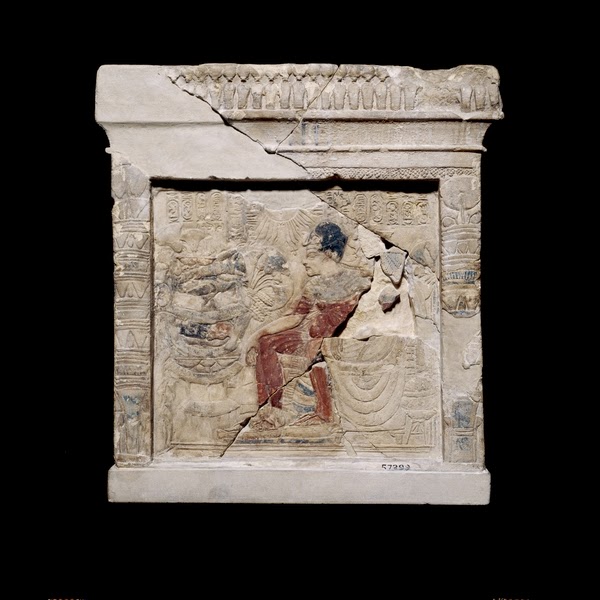
Shire stela of Amenhotep III and Tiye

 Shire stela of Amenhotep III and Tiye

From the house of Panehsy, Tell el-Amarna, Egypt
18th Dynasty, around 1340 BC
Probably from a domestic shrine
The reign of King Amenhotep IV (Akhenaten) (1352-1336 BC) brought a very different style of art to Egypt for a few years. This is clearly associated with the religious changes which Akhenaten started, centred around the cult of the sun disc, known as the Aten. Features of this style include the use of more relaxed poses, accentuated stomachs and heads, and the motif of the sun disc with its life-giving rays.
In the new theology of Amarna, Akhenaten was the sole intermediary of the Aten, and thus all addresses to the deity had to go through him. Houses contained small shrines to the king for this purpose. The shrine in the house of Panehsy contained this plaque that unusually shows Akhenaten's father, Amenhotep III (1390-1352 BC) beneath the sun disc, in the style usually confined to Akhenaten and his officials, though Amenhotep III did identify himself with the sun in the later years of his life.
The name of the old god Amun was proscribed on monuments of the Amarna Period, and so Amenhotep III is identified here by his throne name Nebmaatre.
A.P. Kozloff and B.M. Bryan, Egypts dazzling sun: Amenhotep (Cleveland Museum of Art, 1992)
E.R. Russmann, Eternal Egypt: masterworks of (University of California Press, 2001)
R.E. Freed, Y.J. Markowitz and S.H. D'Auria (eds.), Pharaohs of the sun: Akhenaten (London, Thames & Hudson, 1999)
S. Quirke and A.J. Spencer, The British Museum book of anc (London, The British Museum Press, 1992)

British museum
britishmuseum.org


Jebel Moya: showing positions of skeleton

Jebel Moya: showing positions of skeleton. Natives sorting

Lower mandible from prehistoric cemetery at Gebel-Moya

Lower mandible from prehistoric cemetery at Gebel-Moya
Collection:  SCM - Ethnography and Folk Medicine
Object Name:  mandibles; human remains
Materials:  bone; teeth
Measurements:  length 127 mm; width 123 mm; height 55 mm


Description:  Lower mandible from prehistoric cemetery at Gebel-Moya, Sudan
Object Number:  A682456

hiijas de Tutankhamón