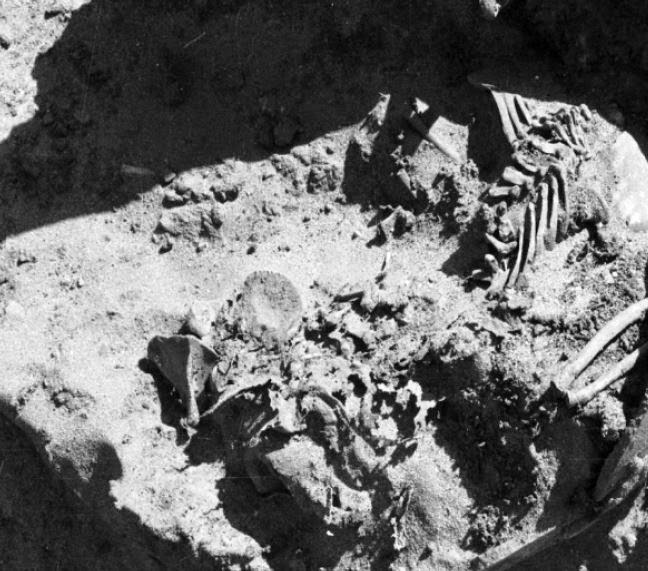
The dog, believed to be a three-month-old female, was unearthed in 2011 on the
Syallakh River in the Ust-Yana region of Yakutia, also known as the Sakha
Republic. Picture: NEFU
Autopsy carried out in Far East on world's oldest dog mummified by ice
By Anna Liesowska18 June 201512,000-year-old remains of puppy were discovered perfectly intact sealed inside permafrost
Scientists in the Russian Far East have carried out a post-mortem examination of the remains of the only mummified dog ever found in the world.
Found sealed inside permafrost during a hunt for traces of woolly mammoths, the perfectly-preserved body is 12,450 years old.
The dog, believed to be a three-month-old female, was unearthed in 2011 on the Syallakh River in the Ust-Yana region of Yakutia, also known as the Sakha Republic.
Experts spent the past four years analysing the body – which included not just bones but also its heart, lungs and stomach – but only carried out the long-awaited autopsy in April.
It took place at the Institute of Medicine within the North-Eastern Federal University in Yakutsk, and experts say the results will 'greatly help' the research of ancient dog species.
Indeed, the study could prove if the animal was an ancestor of modern-day domestic pets.
Dr Darima Garmaeva, professor of the NEFU Medical Institute, said: 'Our task is to estimate the preservation of the ancient animal tissues at the macro and micro level.
'What is of real interest is the fact the animal has a completely preserved carcass, which is unique by itself, with nothing like it in the world. Although the tissues are mummified, they have no post-mortem decomposition, as it usually happens with biological material.'
The mummified puppy was found by brothers Yury and Igor Gorokhov, about 42 kilometres from their home in the village of Tumat, as they were looking for mammoth tusks.
They got in touch with scientists at NEFU and the unidentified remains were excavated before the experts said they belonged to a dog.
It is believed the animal – which was named the Tumat dog, after the village – had died in a landslide at the water's edge and analysis aged it to about 12,450 years.
From 2011, a number of international scientists, including specialists from Belgium, Canada and Germany, became involved in examining the remains.
In August 2014, Dr Mietje Germonpre, from the palaeontology department of the Royal Belgian Institute of Natural Sciences, travelled to Yakutsk to see them.
She said at the time: 'After studying the mummy and looking at the measurements of the skulls belonging to ancient dogs and wolves, I can say this find is unique.
'It's amazing. In other museums around the world you will only find the remains of adult dogs, but this is a puppy. Also all external signs and scan results indicate that it is a primitive dog, and at the moment it is the most ancient one found in northern Siberia.
'The oldest dog remains were found in the Goyet cave in Belgium, and were 36,500 years old, and there are many finds dating to about 26,000 years ago - but they are not so well preserved. Here we see the skin and wool and even the internal organs survived.'
The Belgian said the animal is the 'oldest mummified dog in the world' and said scientists hope it will help chart the ancestry to today’s domesticated canines.
It could be that it belonged to an early domestic breed that lived with the people of Central Asia and went on to settle in the American continent.
'There are two main theories,' said Dr Germonpre. 'The first is that dogs arrived near sites where humans lived and picked up the scraps and gradually they co-existed. The second version talks about the active involvement of man, where the people themselves were the initiator of the relationship, and brought the puppies to their home and trained them.
'The data that I have accumulated speaks in favour of the latter theory. Now we can get more arguments.'
During the post-mortem at Yakutsk, the experts found parts of the dog’s insides intact, including remains of the heart, liver, lungs, and part of the intestine as well as the stomach, complete with its contents.
What intrigued them most was that two pieces of twigs, about one centimetre in length, were found inside the stomach. One theory is that as the puppy fell to its death from the landslide it attempted to grab onto nearby plants with its mouth.
A further examination of the stomach will take place in the autumn, while some tissue samples have also been passed on to Tohoku University in Japan for analysis.
Sergey Fedorov, head of the Tumat dog research project, said: 'Near the place where the dog was found local people often find things that obviously belonged to ancient humans, such as stone implements and bone arrowheads.
'We plan to go to the site this summer together with the archaeologists to find any traces left by humans - and possibly the owners of the dog.'
http://siberiantimes.com/science/casestudy/features/f0121-autopsy-carried-out-in-far-east-on-only-mummified-dog-ever-found-in-the-world/