miércoles, 25 de marzo de 2015
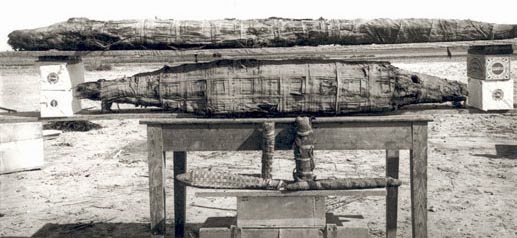
cocodrile mummy

Takabuti


http://www.bbc.co.uk/ahistoryoftheworld/objects/tutDFWOCQqWlM8jEOwMABg
vídeo en el enlace
Takabuti was a married woman who reached an age of between twenty and thirty years. She lived in the Egyptian city of Thebes at the end of the Twenty-fifth dynasty of Egypt. Her mummified body and mummy case are in the Ulster Museum, Belfast.[1] The coffin was opened and the mummy unrolled on 27 January 1835 in Belfast Natural History Society’s museum at College Square North. Edward Hincks, a leading Egyptologist from Ireland was present and deciphered the Egyptian hieroglyphs which revealed that she was mistress of a great house. Her mother’s name was Taseniric and her father was a priest of Amun. She was buried in a cemetery west of Thebes.
After the Napoleonic Wars there was a brisk trade in Egyptian mummies. Takabuti was purchased in 1834 by Thomas Greg of Ballymenoch House, Holywood, Co. Down. At that time the unwrapping of a mummy was of considerable scientific interest (as well as curiosity) and later studies revealed beetles later identified as N. mumiarum Hope, 1834, Dermestes maculatus DeGeer, 1774 (as Dermestes vulpinus) and Dermestes frischi Kugelann, 1792 (as Dermestes pollinctus Hope, 1834). The painted coffin was itself of considerable interest and the wrappings of fine linen were given much attention in the town that was the commercial centre of the Irish linen industry. One hundred and seventy years later Takabuti remains a popular attraction for visitors, young and old
wiki

Takabuti was a married woman who reached an age of between twenty and thirty years. She lived in the Egyptian city of Thebes at the end of the Twenty-fifth dynasty of Egypt. Her mummified body and mummy case are in the Ulster Museum, Belfast.[1] The coffin was opened and the mummy unrolled on 27 January 1835 in Belfast Natural History Society’s museum at College Square North. Edward Hincks, a leading Egyptologist from Ireland was present and deciphered the Egyptian hieroglyphs which revealed that she was mistress of a great house. Her mother’s name was Taseniric and her father was a priest of Amun. She was buried in a cemetery west of Thebes.
After the Napoleonic Wars there was a brisk trade in Egyptian mummies. Takabuti was purchased in 1834 by Thomas Greg of Ballymenoch House, Holywood, Co. Down. At that time the unwrapping of a mummy was of considerable scientific interest (as well as curiosity) and later studies revealed beetles later identified as N. mumiarum Hope, 1834, Dermestes maculatus DeGeer, 1774 (as Dermestes vulpinus) and Dermestes frischi Kugelann, 1792 (as Dermestes pollinctus Hope, 1834). The painted coffin was itself of considerable interest and the wrappings of fine linen were given much attention in the town that was the commercial centre of the Irish linen industry. One hundred and seventy years later Takabuti remains a popular attraction for visitors, young and old.
-----------------

The mummy returns
She's back.
The Egyptian mummy - a source of fascination for children since she came to Belfast in 1834 - had been in storage as the Ulster Museum went through a major refurbishment over a period of nearly three years.
But she has returned to her home at the corner of Belfast's Botanic Park and will be ready to receive visitors when the new-look museum opens in October.
The mummy has always been a major draw for the museum.
But curators dismissed as "urban myth" a popular story that the mummy once contracted a bad case of nits from the children of Belfast and ended up under glass to protect herself.
"She dates from 660 BC and was the daughter of a priest living in Thebes in the Valley of the Kings," said Dr Jim McGreevy, head curator at National Museums Northern Ireland.
"She was a lady of some standing. Her grave goods indicate that she was important and her family was important at that time in ancient Egypt," he said.
"She has been a source of wonder and awe in Belfast too."
He said there were no curses attached to this particular mummy and the museum staff had "nothing but respect" for her.
In the new-look museum, visitors will be able to see a facial reconstruction of Takabuti to get an idea of what she really looked like.
Given the Hollywood fascination with mummies and museums - The Mummy and A Night at the Museum were big hits - the museum is expecting thousands of visitors when it reopens in October.
"We have been extremely busy over the past few months and we are looking forward to the reopening," said Dr McGreevy.
"We are on the last legs of the work and are anticipating considerably bigger numbers
http://news.bbc.co.uk/2/hi/uk_news/northern_ireland/8123849.stm
domingo, 22 de febrero de 2015
Mummy with an Inserted Panel Portrait of a Youth

Mummy with an Inserted Panel Portrait of a Youth
Period: Roman Period
Date: A.D. 80–100
Geography: From Egypt, Fayum, Hawara (Hawwara, Hawwaret el-Maqta; Adlan), Petrie excavations
Medium: Encaustic on limewood, linen, human remains
Dimensions: mummy: l. 169 cm (66 9/16 in); w. 45 cm (17 11/16 in) panel as exposed: l. 38.1 cm (15 in); w. 18 cm (7 1/16 in)
Credit Line: Rogers Fund, 1911
Accession Number: 11.139
This mummy retains the panel inserted over the face. The portrait depicts a youth with large deep-set eyes and a down-turned mouth. His downy moustache indicates that he is no older than his early twenties. A number of mummy portraits represent youths with their first facial hair, a feature that had particular connotations in the Greek-educated society of Roman Egypt. The incipient moustache was both an indicator of the young man's entrance into important social groups and a signal that he was at the prime of sexual attractiveness and vigor.
In this era mummies might be kept above ground for periods of some months up to several years before final burial. Most probably they were deposited in chapels in cemeteries, where they were visited by relatives for ritual meals.
In this era mummies might be kept above ground for periods of some months up to several years before final burial. Most probably they were deposited in chapels in cemeteries, where they were visited by relatives for ritual meals.
Met museum
metmuseum.org
sábado, 21 de febrero de 2015
mummy of ibis

Animal Mummy of ibis decorated with appliqué of Ibis-headed god
Period: Late Period–Roman Period
Date: ca. 400 B.C.–100 A.D.
Geography: From Egypt, Memphite Region, Saqqara; includes the Serapeum
Medium: Linen, animal remains
Dimensions: l. 36 cm (14 3/16 in)
Credit Line: Gift of James Douglas, 1890
Accession Number: 90.6.104
Sacred animals had always figured in ancient Egyptian religion, but beginning about the 7th century the phenomenon of sacred animal cults burgeoned remarkably. In some temples a single sacred animal acted as the living incarnation of a god, in others living species were kept within the temple precincts, and there were also temples and sanctuaries attached to the burial places of sacred animals.
Most of the animal mummies in museums today are from among the hundreds of thousands or more made for sale to those wishing to make donations to a relevant divine animal or god in order to bring themselves to the god’s attention, perhaps for a specific purpose like a dream interpretation or a wish for fertility, perhaps for a better eternal life.
Research on animal mummies has shown that the majority of mummies found at the large animal cemetery sites are pre-adults who were purposely killed for use as donations. Some of the mummies are actually ‘substitute’ mummies containing only a few bones or feathers or possibly just sticks or sand.
Recently a review of the museum's animal mummies and their x-rays was conducted in consultation with an expert in their study, and brought to light a number of interesting points. In this particular case the wrappings include an elaborate applique of the ibis-headed Thoth with anthropomorphic form seated on a throne, while the contents are some bones but no organized animal mummy
Most of the animal mummies in museums today are from among the hundreds of thousands or more made for sale to those wishing to make donations to a relevant divine animal or god in order to bring themselves to the god’s attention, perhaps for a specific purpose like a dream interpretation or a wish for fertility, perhaps for a better eternal life.
Research on animal mummies has shown that the majority of mummies found at the large animal cemetery sites are pre-adults who were purposely killed for use as donations. Some of the mummies are actually ‘substitute’ mummies containing only a few bones or feathers or possibly just sticks or sand.
Recently a review of the museum's animal mummies and their x-rays was conducted in consultation with an expert in their study, and brought to light a number of interesting points. In this particular case the wrappings include an elaborate applique of the ibis-headed Thoth with anthropomorphic form seated on a throne, while the contents are some bones but no organized animal mummy
Met Museum
metmuseum.org
Ibis mummy inside a jar

Period: Late Period–Ptolemaic Period
Date: ca. 400 B.C.–100 A.D.
Geography: From Egypt, Northern Upper Egypt, Abydos, Ibis Cemetery, Egypt Exploration Fund excavations, 1912–13
Medium: pottery, animal remains, linen
Dimensions: (a-b jar, mummy) H. 43 cm (16 15/16 in.); Diam. 19.5 cm (7 11/16 in.) (c-lid) H. 10.8 cm (4 1/4 in.); W. 16.5 cm (6 1/2 in.); D. 7 cm (2 3/4 in.)
Credit Line: Gift of Egypt Exploration Fund, 1913
Accession Number: 13.186.4a–c
This jar contains an ibis mummy wrapped in linen. The lid, now open, was anciently replaced over the opening and sealed with lime plaster. This mummied creature was discovered with many others, some single burials, other group burials in large jars, in a concentration east of the processional way at Abydos. Most of the mummies in this concentration seem to have dated even to the Roman Period, although others nearby in the newly recognized north cemetery temple and catalcombs belong to the Ptolemaic Period.
Animal mummies are generally envisioned as being offered to the corresponding god - for the ibis that would be Thoth. However, there are no known temples to the god Thoth at Abydos. On the other hand, Thoth ws closely involved both in the confirmation of the king and in the justification and rebirth of the deceased king, so it has been suggested that ibises may have been offered in support of divine kingship, Abydos being the seat of the most ancient kings, and, in specific, of Osiris.
http://www.metmuseum.org/
Met Museum
viernes, 20 de febrero de 2015
Mummy of Tasheriteniset

Mummy of Tasheriteniset with mummy mask and other cartonnage elements, also with garland of plants
Period: Ptolemaic Period
Date: 305–30 B.C.
Geography: From Egypt, Middle Egypt, Asyut (Assiut, Siut; Lykopolis)
Medium: Human Remains, linen, cartonnage, paint, gold leaf, plant remains
Dimensions: L. 145.2 cm (57 5/16 in.)
Credit Line: Rogers Fund, 1912
Accession Number: 12.182.48a
This mummy belongs to the woman Tasheriteniset. Her mummy has a painted cartonnage mask and foot covering, and there are garlands on her chest. Her mummy mask features the depiction of earrings and of a headband with a golden wedjat eye amulet.
Met Museum
metmuseum.org
Mummy of cat

Mummy of cat
Period: Late Period–Roman Period
Date: ca. 400 B.C.–100 A.D.
Geography: From Egypt
Medium: Linen, ink, animal remains
Dimensions: l. 34 cm (13 3/8 in)
Credit Line: Gift of Mrs. Frederick F. Thompson, 1915
Accession Number: 15.6.50
Sacred animals had always figured in ancient Egyptian religion, but beginning about the 7th century the phenomenon of sacred animal cults burgeoned remarkably. In some temples a single sacred animal acted as the living incarnation of a god, in others living species were kept within the temple precincts, and there were also temples and sanctuaries attached to the burial places of sacred animals.
Most of the animal mummies in museums today are from among the hundreds of thousands or more made for sale to those wishing to make donations in connection with regular festivals or perhaps to address themselves to a particular god for a purpose suchas dream interpretation or a wish for fertility or for a better eternal life.
Research on animal mummies has shown that the majority of mummies found at the large animal cemetery sites are pre-adults who were purposely killed for use as donations. Some of the mummies are actually ‘substitute’ mummies containing only a few bones or feathers or possibly just sticks or sand.
Recently a review of the museum's animal mummies and their x-rays was conducted in consultation with an expert in their study, and brought to light a number of interesting points.This mummy is wrapped in a checkerboard pattern created by two slightly different shades of beige linen; inside the bundle is a perfectly preserved skeleton of a cat just reaching maturity, whose neck had been broken.
Most of the animal mummies in museums today are from among the hundreds of thousands or more made for sale to those wishing to make donations in connection with regular festivals or perhaps to address themselves to a particular god for a purpose suchas dream interpretation or a wish for fertility or for a better eternal life.
Research on animal mummies has shown that the majority of mummies found at the large animal cemetery sites are pre-adults who were purposely killed for use as donations. Some of the mummies are actually ‘substitute’ mummies containing only a few bones or feathers or possibly just sticks or sand.
Recently a review of the museum's animal mummies and their x-rays was conducted in consultation with an expert in their study, and brought to light a number of interesting points.This mummy is wrapped in a checkerboard pattern created by two slightly different shades of beige linen; inside the bundle is a perfectly preserved skeleton of a cat just reaching maturity, whose neck had been broken.
Metropolitan Museum
metmuseum.org
Suscribirse a:
Entradas (Atom)